

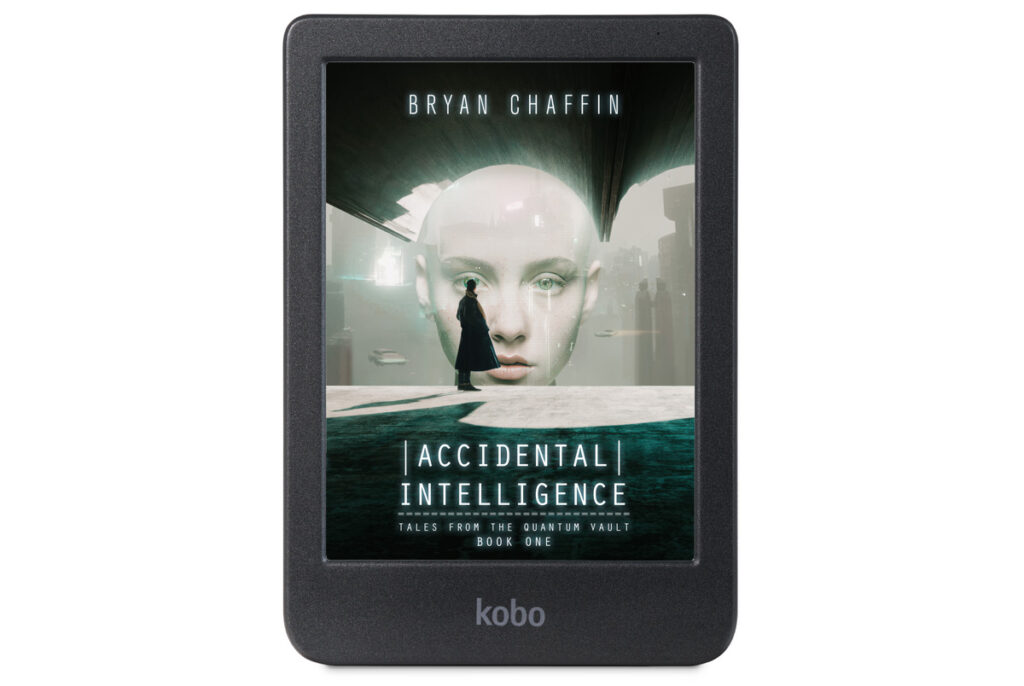
Kobo and Kobo Plus
As noted in my piece about joining the Thousand Book Club™, I put both of my books on Kobo and Kobo Plus. It turns out Kobo has many users, and they tend to be kind of rabid fans of the platform. Who knew? I do—now—and I regret not having embraced Kobo sooner.
What Is Rakuten Kobo?
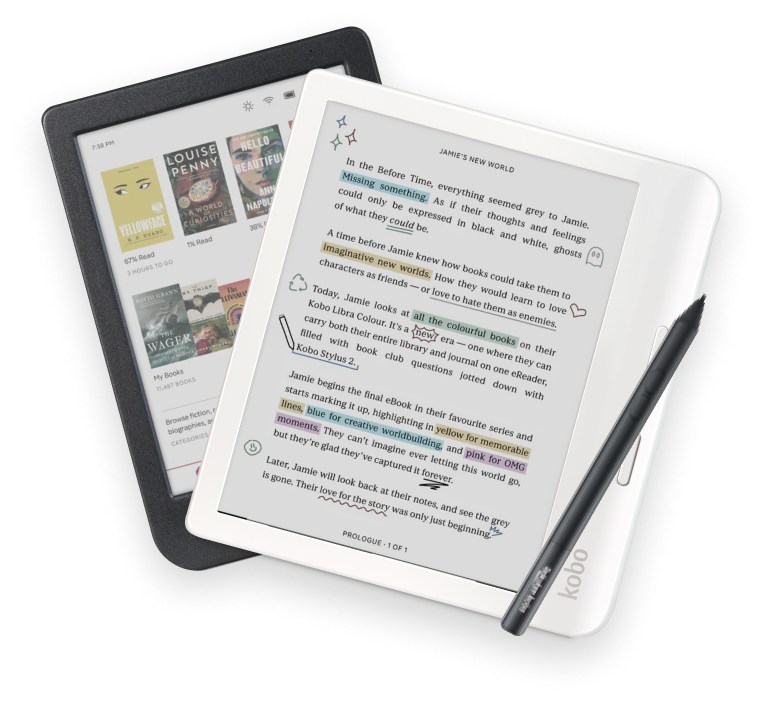
Kobo is a third-party ebook platform that has been purchased by the Rakuten conglomerate. They have their own ebook readers—like Kindle and Nook—and seem to be pursuing the ebook market vigorously. Currently, 7 of their ereader models support audiobooks, in addition to ebooks.
For bonus points, follow Kobo CEO Michael Tamblyn on Threads, where he is a bit of a maniac and quite entertaining.
What Is Kobo Plus?
Kobo Plus is their all you can-eat-service where you pay a monthly subscription fee and can read and/or listen to any title that has been opted in to that service by the author/publisher. Kobo Plus is currently priced at $7.99 for either reading OR listening, or $9.99 for reading AND listening. That price allows you to download and read/listen to whatever you want (as long as you’re paying).
As an author, if I’ve opted my titles into Kobo Plus, I’m paid according to the number of minutes subscribers spend reading my books compared to the total number of minutes read across the entire Kobo Plus system. The pool of subscriber money is then divvied up accordingly. This can result in not a lot of money per book for authors, but it’s also a fantastic deal for readers and hopefully encourages reading.
Amazon’s Kindle Unlimited
This is similar to how Amazon’s Kindle Unlimited (KU) works. Amazon’s KU uses the number of pages read, rather than the number of minutes read. Also, with Kobo there’s no exclusivity requirement like there is with KU. Why the DOJ lets Amazon get away with that exclusivity requirement is beyond me. It absolutely locks authors—indie authors in particular—into the Zon, which I think is bad for authors and readers alike.
Fortunately, there is growing discontent with Amazon concerning that exclusivity clause from independent authors. Also, trad publishers (that’s mostly the Big Four and their imprints) get to play by different rules. That’s infuriating.
The problem with KU is that there are plenty of authors who make relatively good money with the service, so they have absolutely no desire to leave it and couldn’t care less about getting this exclusivity agreement changed. I’ll keep my eye on the big picture.
My First Few Month with Kobo Plus
Results for Kobo Plus are updated monthly, and I haven’t had enough minutes read to even get a report. They have a 300 minute minimum before you get a report. As I release more books, I’m sure I’ll eventually get that report.
My Overall Sales on Kobo
As I’m also working on my article about joining the Two Thousand Book Club (!!), Kobo has been my slowest platform. I’ve moved 112 books, with 111 copies of King Liam and only one copy of Accidental Intelligence. Like I said, it’s been my slowest platform to date, but I’m delighted to reach 112 people with stories from Mason Truman’s universe.
If you’re looking for an ebook platform that’s run by a lovable maniac, rather than a conceited, self-aggrandizing oligarch, definitely give Kobo a try. There are apps for Mac, iOS, and Android, and they have a wide range of ereader devices. And, Kobo is available in 46 countries, as of this writing.
2 Responses
I am wary of unknown or new authors who say they make “tons” on KU. 1) their idea of “tons” is not mine, and 2) they have nothing to compare it to or they can only make false comparisons. When I ask how they did with non-KU books, they cannot tell me. I am a trad published and indie pubbed author with about 35 titles under my belt, and when I tried KU–new book of comparable length and series release # so I could compare it to non-KU released new books–I made far less in KU than in non-KU sales. For me, it might be the place to put an old book whose regular sales have been exhausted, in an attempt to pick up new readers who are too cheap to pay for a book, but that’s only a very few. To me, KU is not worth it. Keep in mind, too — when Amazon states how many millions are going into the KU author pool, that money very rarely trickles down to unknown or mid-list authors and newbies. Remember: people like Julia Quinn, Stephen King, etc., have publishers who put their books onto KU; who do you think the money pool is going to go to…these people or a new author no one has ever heard of? Also, Amazon promotes its own imprint far more than others, which means their imprint books are going to have more sales. Further, KU is paid by the number of pages read; if your book is text dense, with long and complex sentences, you will make less than people who post books with pages that are mostly white space and lots of small paragraphs. I’ve seen this happen in the past 10 years in historical romance (my genre). Used to be that this genre had lots of wonderful description and character reflection. Now if you look at the books published more recently, the paragraphs are short, the books are filled with dialogue over description, and the chapters are incredibly short–all done to increase the speed of readers so as to increase the speed of pages and increase the profit. KU and Kobo Plus? No. But yes to Kobo’s regular sales–every author should be on the big five sites–Amazon, B&N, Kobo, iBooks, and Google. Othe sites after that are pocket change in terms of sales for most authors. You’ll have to decide it the effort to go up onto other sites are worth the time and effort when compared to the little you’ll make.
Thanks for the perspective, Anna. I agree, KU is not worth it.